Technical White Paper
Costume & Theatrical Contact Lens Engineering: Material Science, Safety Thresholds & Micro-Encapsulation
An authoritative engineering breakdown of biocompatibility, oxygen transmissibility ($Dk/t$), and lathe-cut vs. cast-molding techniques for medical device importers.
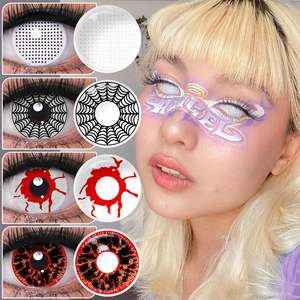
In the global medical device sector, cosmetic and costume contact lenses occupy a critical regulatory crossroad. Although frequently marketed as novelty, fashion, or Halloween accessories, international governing bodies—including the United States Food and Drug Administration (FDA Class II/III), the European Union Medical Device Regulation (EU MDR 2017/745 Annex VIII Rule 5), and the China National Medical Products Administration (NMPA Class III)—classify colored and zero-powered plano costume lenses strictly as medical devices. Sourcing costume lenses requires rigorous validation of polymer matrices, tint encapsulation stability, edge profile biomechanics, and sterile barrier preservation.
Key Engineering Axiom: The primary clinical hazard in sub-standard costume lenses is direct corneal exposure to non-encapsulated organic/inorganic pigments. Our manufacturing protocols utilize a true 3-layer Sandwich Polymerization matrix, sealing all iron oxide, titanium dioxide, and phthalocyanine pigments inside inert PolyHEMA layers to ensure complete ocular safety.
1. Pigment Encapsulation: The Sandwich Method vs. Surface Printing
Conventional low-cost novelty contacts often print ink directly onto the posterior or anterior surface of the hydrated lens. This hazardous technique exposes the delicate corneal epithelium and palpebral conjunctiva to mechanical friction, surface micro-roughness, and potential toxic leaching of pigment binders. Over an 8-hour wear period, friction against rough pigment deposits can cause corneal abrasions, giant papillary conjunctivitis (GPC), and secondary microbial keratitis.
Our OEM manufacturing facility executes an advanced Triple-Layer Cast-Molding Sandwich Technology. The color pattern is pad-printed onto a partially cured lower hydrogel film within an optical mold. A secondary monomer layer is injected and cured under uniform UV/thermal photopolymerization. The final product isolates all coloring agents inside the optical polymer matrix. Surface profilometry verifies that the lens surface maintains an optical-grade root-mean-square (RMS) smoothness under 5 nanometers—identical to uncolored prescription lenses.
2. Comparative Material Science Matrix for SFX & Cosmetic Contacts
| Polymer System |
Water Content (%) |
Dk/t (@ -3.00D) |
Modulus (MPa) |
Optimal Use Scenario |
Wear Schedule |
| PolyHEMA (Polymacon) |
38% - 40% |
14 - 18 |
0.45 - 0.55 |
High-opacity theatrical SFX, stable pigment lock |
Daily / Monthly / Yearly |
| HEMA-GMA Copolymer |
42% - 45% |
20 - 24 |
0.38 - 0.45 |
Cosplay dolly-eye, extended hydration retention |
Daily / Monthly |
| Silicone Hydrogel (SiHy) |
48% - 55% |
80 - 110+ |
0.60 - 0.75 |
Premium cosmetic & prescription blended lines |
Daily Disposable |
| Sclera Rigid/Semi-Rigid Gas Permeable |
< 1% |
100 - 140 |
1.10 - 1.30 |
Full 22mm custom Hollywood special effects |
Custom Theatrical |
3. Rotational Ballast Dynamics for Theatrical Slit Pupils & Cat Eyes
A classic technical problem in costume contact lenses is pupil decentration and axis rotation in non-rotationally symmetric designs—such as feline slit eyes, goat eyes, and anime Sharingan markers. Free-floating hydrogel lenses naturally rotate between 15° to 90° on the cornea due to eyelid shear forces during blinking.
To eliminate this failure mode, our R&D laboratory manufactures custom Prism Ballast & Dual-Thin Zone Stabilization Geometries. By shifting the lens center of gravity toward the inferior edge through micro-differential thickness profiling, our cat-eye and directional cosplay lenses automatically self-orient to the true vertical 90° axis within 3 blinks of insertion, preventing disorienting optical skew.