Engineered to transform even the deepest natural irises. Explore our precision cast-molded series, fully customizable secondary packaging architectures, and high-speed automated packaging systems available for private label deployment.
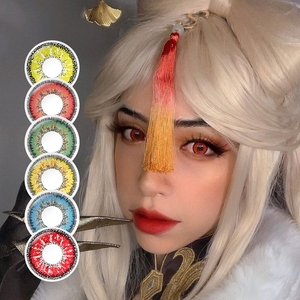 Theatrical / Cosplay
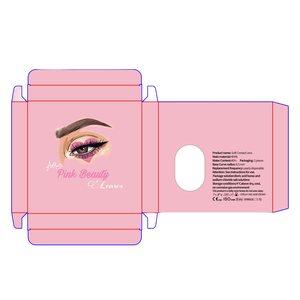 OEM Packaging
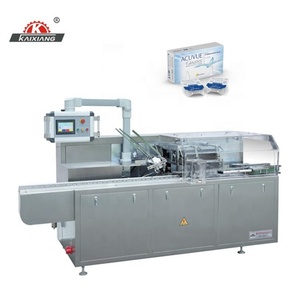 Automation
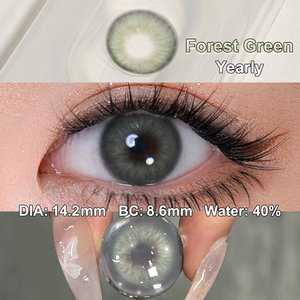 Cosmetic Natural
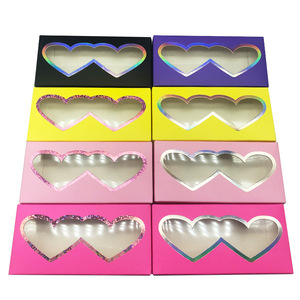 Private Label Pack
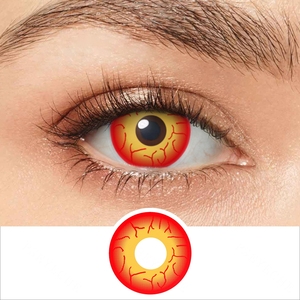 Anime / Character
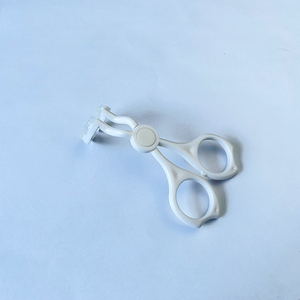 Medical Device Tool
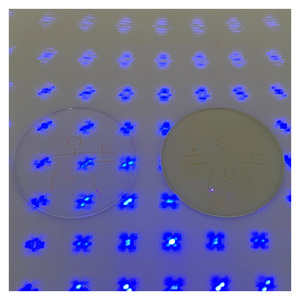
Unlike conventional cosmetic lenses that utilize superficial pad-printing, our contract manufacturing operation centers on clinical safety, high visual acuity, and complete dark-eye pigment occlusion without compromising ocular physiology.
Sandwich Bio-Encapsulation
We lock cosmetic colorants completely within dual-polymerized layers of hydrogel or silicone hydrogel. Zero reactive monomer or pigment molecule ever contacts the corneal epithelium or palpebral conjunctiva, eliminating mechanical abrasion risks.
High-Opacity Micro-Matrix
Full coverage contacts require extreme opacity to neutralize dark brown or black natural irises (Fitzpatrick levels V and VI). Our proprietary nano-dot printing algorithm delivers 99.8% visual masking while preserving a crystal-clear 4.2mm pupillary aperture.
Continuous Dk/t Optimization
High-density pigment layers traditionally choke oxygen diffusion. Our micro-pore cast-molding technology ensures oxygen transmissibility ratings up to 84 Dk/t for daily hydrogels and 138 Dk/t for advanced silicone hydrogel formulations, safeguarding ocular health.
Class 10,000 Cleanroom Operations
Every cast molding line, optical stripping workstation, hydration chamber, and blister heat-sealing apparatus operates strictly within ISO Class 7 and Class 8 (10,000–100,000 level) environments under continuous laminar air purification.
Automated Inline Metrology
Using high-resolution CCD cameras and interferometric edge-profile sensors, 100% of finished lenses undergo automated inspection for optical zone concentricity, surface flash, center thickness (±0.005mm), and edge taper smoothness.
End-to-End Packaging Line
From medical-grade foil thermoforming and autoclave terminal sterilization (121°C, F0 ≥ 15) to custom cartoning machine deployment, our turnkey packaging lines produce shelf-ready, market-cleared units for your branded footprint.
The market for cosmetic and full-coverage contact lenses is undergoing a massive structural shift away from generic, uncertified novelty items toward clinical-grade, high-compliance beauty eyewear.
1. The Transition to Daily Disposable (Dailies) Form Factors
Historically, full coverage theatrical and intense cosmetic contacts were dominated by 6-month and annual replacement modalities due to high pad-printing setup costs. However, international regulatory audits and consumer hygiene preferences have pushed annual volume toward daily disposables. Dailies virtually eliminate corneal ulcer risks associated with storage compliance errors. Progressive B2B distributors are currently converting 40-50% of their legacy annual portfolios into 10-pack and 30-pack daily blister cartons.
2. Silicone Hydrogel Adoption in Color Cosmetics
While standard 2-HEMA (2-hydroxyethyl methacrylate) hydrogels with 38%-45% water content remain the workhorse of the industry, high-tier retail brands demand silicone hydrogel (SiHy). The integration of fluoro-silicone macromers allows lenses to maintain clinical lubricity and moisture retention over 14+ hours of continuous wear. Sourcing teams seeking long-term brand equity are specifying hybrid matrix materials that accommodate high-density opaque pigments without causing hypoxic stress.
3. Heightened Global Regulatory Barriers (EU MDR & US FDA 510(k))
The enforcement of the EU Medical Device Regulation (MDR 2017/745) has categorized all contact lenses—even non-corrective plano cosmetic lenses—under strict Class IIa scrutiny (Annex XVI). In the United States, 21 CFR 886.5925 mandates prescription verification for plano fashion lenses. Contract buyers can no longer rely on brokers lacking primary technical documentation. Verifiable biocompatibility testing (ISO 10993 cytotoxicity, systemic toxicity, and ocular irritation) is now a mandatory condition of entry.
4. Prescription Inclusivity: Toric & Multifocal Colored Contacts
Cosmetic wearers no longer accept sacrificing visual sharpness for eye color aesthetics. Over 32% of prospective contact lens users require astigmatic (cylinder) correction, while the aging demographic demands presbyopia correction. Modern OEM manufacturing requires prism-ballast or peri-ballast toric stabilization paired with precise multi-tone full coverage iris patterns. Offering cosmetic corrections up to -2.50D cylinder and +2.50D ADD represents the single highest margin expansion opportunity for brand owners.
Achieving 100% natural-looking color transformation over dark brown or jet-black eyes without creating a flat, artificial "doll eye" appearance requires a sophisticated balance of optical parameters.
| Engineering Parameter | Conventional Cosmetic Lens | High-Precision Full Coverage OEM Lens | Clinical & Aesthetic Rationale |
|---|---|---|---|
| Pigment Encapsulation Method | Surface-printed or single-sided transfer | Triple-layer interstitial sandwich encapsulation | Guarantees zero pigment shedding, eliminates foreign body sensation, and protects corneal tissues. |
| Pupillary Aperture (Clear Zone) | Static 3.0mm – 3.5mm aperture | Gradient transitional 4.2mm – 5.0mm optical zone | Eliminates "tunnel vision" and visual vignetting under scotopic (low-light) conditions when the pupil dilates. |
| Halftone Dot Resolution | 150 – 300 DPI pad printing | 600 – 1200 DPI stochastic micro-dot matrix | Mimics real human iris trabeculae structure, preventing the artificial look when viewed up close. |
| Radial Edge Geometry | Standard blunt-cut edge profile | Multi-curve rounded contour (tangential design) | Facilitates continuous tear film replenishment behind the lens with every eyelid blink. |
| Available Replacement Modalities | Predominantly 6-Month or Annual vials | Daily, Monthly, Quarterly, and Yearly blisters/vials | Enables comprehensive multi-channel pricing strategies across pharmacy, beauty retail, and clinics. |
Critical technical, regulatory, and production insights designed to help supply chain directors, brand founders, and optical buyers make risk-free procurement decisions.
For our existing library of over 120 proven full coverage color formulations, private-label branding with custom outer packaging starts at approximately 300 to 500 pairs per color/SKU. For completely bespoke pattern design, custom graphic diameters (G.DIA), or unique color formulations requiring laser-etched printing plates and cast-molding tool calibration, the standard production threshold begins at 3,000 to 5,000 pairs per master color run. Flexible order scaling across multiple diopters (powers) is available once the base tooling is established.
We use FDA-approved medical-grade cosmetic colorants (such as Iron Oxides, Titanium Dioxide, Copper Phthalocyanine, and Chromium Oxide Greens) that are non-reactive and insoluble in physiological solutions. Our interstitial sandwich process embeds these pigment particles completely inside the crosslinked polymer matrix. Each finished production batch undergoes stringent continuous Soxhlet extraction testing, gas chromatography (GC) residual monomer analysis, and cytotoxicity assays under ISO 10993 standards to certify absolute bio-inertness.
We supply a complete regulatory dossier customized to your target jurisdiction. This includes: Full Quality Management System Certificates (ISO 13485:2016), Certificates of Free Sale (CFS), CE Certificates, Device Master Record (DMR) summaries, sterilization validation reports (ISO 11137 / ISO 17665), accelerated 5-year shelf-life stability data, packaging barrier integrity validations, and full biocompatibility reports. For US FDA 510(k) or EU MDR applications, our technical team works directly with your authorized representative.
Yes. While the standard Western optical configuration is 14.2mm total diameter (DIA) with an 8.6mm base curve (BC), we manufacture lenses ranging from 14.0mm to 14.5mm DIA and 8.4mm to 8.8mm BC to suit Asian, Middle Eastern, European, and Latin American corneal topographies. Moisture content can be tuned between 38% and 42% for stable dimensional durability in extended wear hydrogels, or up to 55%-58% in high-water daily matrices designed for air-conditioned and arid climates.
Pre-production sample verification and color proofs for in-stock molds require 7 to 14 calendar days. Upon client sign-off on packaging proofs, barcode assignments, and regulatory labeling, mass cast-molding, hydration, autoclave processing, and inline cartoning are completed in 30 to 45 business days. Rapid replenishment programs with guaranteed buffer stocks are negotiated for recurring annual contracts.
A disciplined 6-stage contract manufacturing pipeline that guarantees total color repeatability, absolute seal integrity, and full regulatory conformity.
Design & Spectrophotometry
We formulate exact pigment combinations using digital spectrophotometer analysis against natural iris references, defining graphic diameter, pupillary transitions, and outer limbal intensity.
Optical Tooling & Molding
Ultra-precision diamond-turned mold inserts generate the convex and concave mold halves. Monomers are precision-dispensed using robotic micro-pipettes under strict atmospheric control.
Polymerization & Hydration
UV and thermal cross-linking cures the hydrogel matrix, permanently locking the encapsulated color layer. The dry lens is released and fully hydrated in buffered isotonic saline.
Inline Metrology & Inspection
Every lens passes through 100% automated optical inspection (AOI) verifying edge contour, concentricity, surface anomalies, and dioptric power accuracy before insertion into primary packaging.
Sealing & Terminal Autoclave
Blisters are sealed with medical-grade multi-layer foil lidding, then subjected to high-temperature saturated steam autoclaving (121°C) ensuring a validated Sterility Assurance Level (SAL) of 10-6.
Automated Secondary Packaging
High-speed packaging machines bundle blisters with serialized cartons, instructions for use (IFU), and tamper-evident seals ready for worldwide container freight or air courier dispatch.
Ready to Engineer Your Private Label Colored Contact Lens Line?
Consult directly with our OEM engineering team. We supply physical sample kits, shade-matching prototypes, technical regulatory dossiers, and competitive volume tier quotations within 24 hours.